

AI Model News: Latest Developments and Innovations in Artificial Intelligence
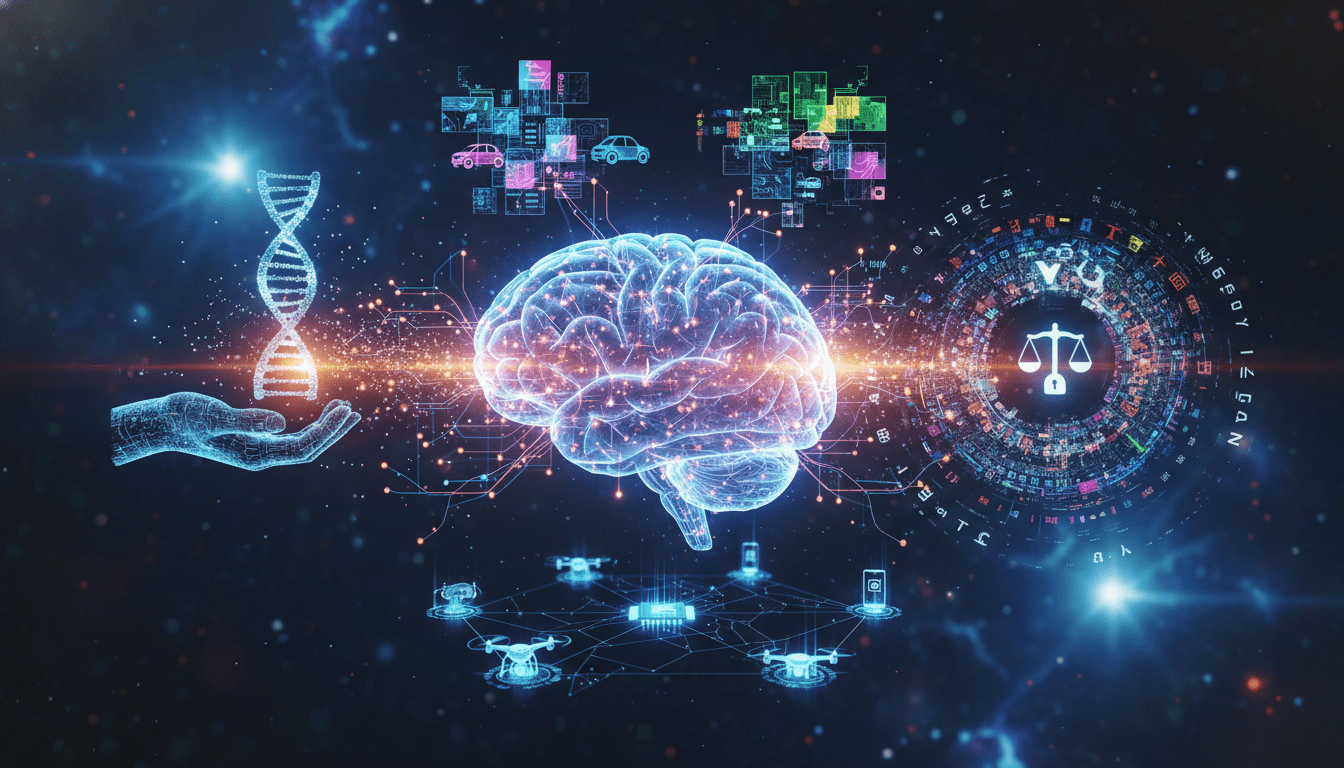
AI model news today reveals rapid breakthroughs across sectors—from developer tools to physical robotics and safety frameworks. These updates span Google’s Gemini enhancements, OpenAI’s self-improving models, Anthropic’s role expansion into space, and new multimodal and tabular AI systems transforming industries.
Major AI Releases Shaping 2026
Gemini: Google’s Multimodal Powerhouse
Google’s Gemini has rapidly evolved with Gemini 3 Pro and Deep Think models launching in late 2025. Gemini 3 Pro leads in reasoning prowess and offers deeply integrated multimodal features. In early 2026, Apple announced a collaboration to base its next-generation Foundation Models—powering the future of Siri—on Gemini technology .
At CES 2026, NVIDIA and robotics partners showcased “physical AI” systems powered by AI models in humanoids and mobile manipulators—highlighting AI’s increasing real-world embodiment .
OpenAI Hits Recursive Autonomy and Developer Tools
OpenAI introduced GPT‑5.3‑Codex, a model that builds, tests, and deploys software with contextual memory and multitasking agent capability . Closely following, the Codex app debuted as an IDE-like interface for agentic development, not just a chat window—and its ‘Agent Skills’ directory offers reusable instructions to automate complex tasks .
Anthropic Delivers Claude Opus 4.6 and Mars-Rover Support
Claude Opus 4.6, released in early February, enhances reasoning and integrates neatly with office tools like PowerPoint and Excel. It even outperforms GPT‑5.2 on legal and finance benchmarks, raising investor concern about AI disrupting niche software markets . In a fascinating leap, NASA applied Claude to route-planning on Mars. The AI autonomously plotted 1,400+ feet of rover movement with minimal human tweaks .
Open-Source Trends and Specialized AI Models
OpenScholar, an open-source AI, excels at academic searches with accurate citations, countering risks of hallucinated references typical in giant LLMs .
Meanwhile, AI startup Fundamental raised $255M to launch Nexus—an enterprise-grade Large Tabular Model (LTM) that handles structured data with deterministic precision, steering away from probabilistic language models .
Research Advances Toward Human-like Cognition
A recent NeuroAI effort introduced NeuTNNs—neuromorphic temporal neural networks that mimic brain structures for efficiency and performance. NeuTNNs cut hardware cost and synapse counts by 30–50% while retaining accuracy . In another breakthrough, researchers added “inner self-talk” and working-memory models to AI, boosting adaptability and task transfer abilities—like giving AI a cognitive monologue .
Infrastructure and Industry Trends
Agentic Operations and Enterprise Automation
Cisco unveiled enhancements to AgenticOps—its agent-powered IT model—expanding across networking, security, and observability, shifting how IT teams orchestrate systems at scale .
Healthcare Meets Scalable AI
Microsoft projects AI’s potential to revolutionize healthcare, from diagnostic tools to treatment planning. The MAI‑DxO diagnostic orchestrator reached roughly 85% accuracy in tests while AI products like Copilot answer millions of health queries daily .
Product Innovation Accelerated by AI
Equifax credits AI and cloud tools with driving record-high innovation in 2025 . Deloitte underscores generative AI’s potential to fuel physical product innovation, leveraging front-office transformation to build smarter, sustainable systems .
Open Platforms and Video AI
Lightricks’ LTX‑2, a 4K text‑to‑video model, became fully open-source in January 2026, democratizing cinematic video generation across the developer ecosystem .
On the open-source front, models like Kimi‑K2.5 are trending on Hugging Face, offering multimodal reasoning—spanning images, text, and more—with wide community adoption .
Physical AI, Edge Intelligence, and Manufacturing
NVIDIA’s CES disclosures introduced the Alpamayo 1 VLA model for autonomous driving and Nemotron for ultra-fast speech ASR, already integrated by partners like Mercedes‑Benz and Bosch .
The Falcon‑H1R 7B model, compact and high-performance, achieved math and coding benchmarks comparable to much larger models, making it ideal for edge deployments in factories and beyond .
Arm forecasts AI will evolve into a unified continuum across cloud, edge, and physical systems in 2026—accelerating real-time, distributed decision-making .
Governance, Safety, and Global Strategy
Safety Leadership and Policy Direction
A landmark update to the Independent International AI Safety Report was released on February 3, 2026, offering new evidence on managing advanced reasoning models ahead of the AI Impact Summit . In parallel, calls for safer, transparent AI systems emphasize governance as essential, not optional .
Expert Insight
“It’s such a crazy time … and it’s only accelerating.”
—Peter Staar, Principal Research Staff at IBM Zurich, reflecting the breakneck pace of AI innovation .
Conclusion
AI model news in early 2026 spells one clear truth: models are becoming more capable, specialized, and integrated across tools that shape industries. From Mars rovers to financial analytics, video creation to hardware efficiency, AI is not just advancing—it’s embedding itself into daily work and strategic innovation. The surge of agentic tools, open models, and cognitive-inspired networks signals a maturing ecosystem that’s fast moving, increasingly accessible, and deeply impactful.
FAQs
What are the most advanced AI models right now?
Gemini 3 Pro, GPT‑5.3‑Codex, and Claude Opus 4.6 stand out for reasoning and agentic capabilities. Open‑source rivals like OpenScholar and Nexus are gaining ground in academic and enterprise use.
Why is agentic AI so significant?
Agentic systems—like Codex agent skills and AgenticOps—can plan and execute tasks autonomously. This transforms workflows into smoother processes and boosts efficiency across development, IT, and business functions.
What is physical AI, and where is it appearing?
Physical AI blends models with robotics or embedded hardware. Notable examples include NVIDIA’s VLA chips for autonomous vehicles and humanoids, and Claude guiding Mars rover navigation.
How is AI addressing safety and transparency?
A new international safety report and governance frameworks prioritize security and ethical deployment, laying groundwork ahead of global summits like the AI Impact Summit.
Are open‑source AI models keeping pace with proprietary ones?
Absolutely. LTX‑2, OpenScholar, Kimi‑K2.5, and Nexus are proof that open models can rival or even outperform larger commercial systems, often with better transparency and reliability.














Leave a comment