

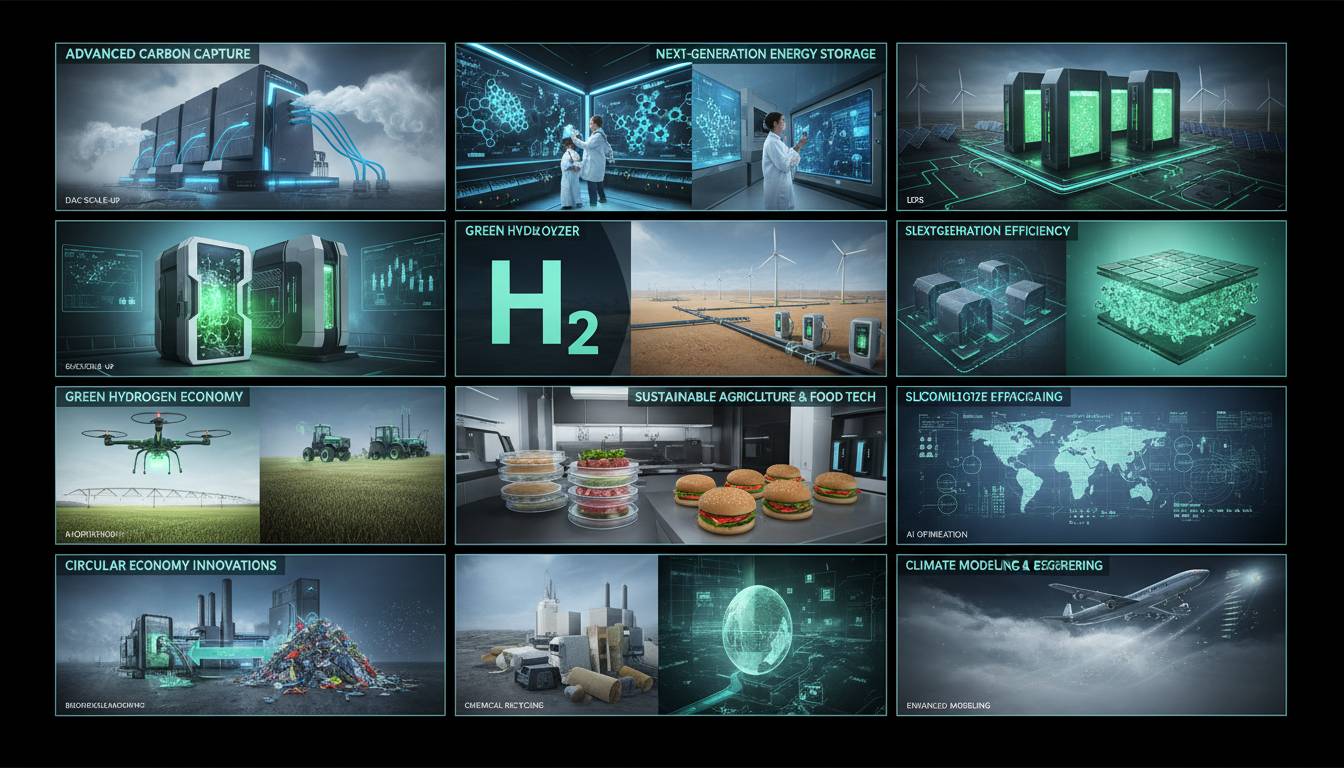
Climate tech is advancing faster than ever. Right now, breakthroughs in solar efficiency, carbon removal, artificial intelligence–driven solutions, and bold funding moves are transforming how we address climate change. Whether you’re curious about the next big innovation or the trends reshaping the industry, here’s what’s happening—and why it matters.
Direct Air Capture and Carbon Utilization
Direct Air Capture (DAC) is stepping out of the lab and into real-world deployment. Researchers at the University of Houston have developed an electrochemical process that captures carbon dioxide at an estimated cost of around $70 per ton, suggesting DAC could become cost-competitive soon. More than 130 new DAC facilities are already in the pipeline. The sector is expanding rapidly—from under $200 million in 2024 to a projected value nearing $260 billion by 2026—thanks to policy incentives and corporate net-zero goals.
Beyond capture, innovation is turning CO₂ into value. French startup Wespran is using enzymes coated on carbon nanotubes to convert flue-gas CO₂ into green methanol. Meanwhile, Carbonetics in India employs AI-powered chemisorption systems to capture emissions at industrial sites, improving efficiency.
These trends show DAC moving from proof of concept to scalable solutions with economic upside and climate benefits.
Solar Tech: Perovskites Make Gains
Perovskite solar cells are changing the game. These panels are lighter, cheaper to produce, and can achieve higher efficiency through tandem stacking over traditional silicon cells. In January 2026, researchers achieved 25.4% efficiency while retaining most of their performance over long testing periods.
Layered (tandem) designs have reached lab efficiencies up to 34.6%. This paves the way for flexible, integrated solar solutions that cut manufacturing costs by up to 40%, making solar deployment more affordable and versatile.
Climate Tech Innovators and Startups to Watch
2026 is brimming with startups bridging climate science and real-world impact:
- Earthbot.io (Dubai): AI-powered platform that helps businesses discover and choose sustainability tools—from energy to ESG dashboards.
- Redwoods.ai (USA): Automates emissions data collection and climate compliance, turning regulatory burden into streamlined reporting.
- Sustainfinity (Netherlands): Focuses on AI-enhanced ESG reporting, offering tools for automated materiality assessments and regulatory-ready reports.
In energy and hardware:
- Tesla Energy has deployed over 43 gigawatt-hours in grid-scale storage in 2025, unveiling the new Megapack 3 and Megablock systems boasting more capacity, faster installs, and lower costs.
- Oklo Inc. and Helion are pioneering small modular nuclear and fusion reactors. Helion’s approach skips steam turbines and may eventually deliver high-efficiency power—cool if it works.
These innovators highlight how AI, advanced manufacturing, and new energy sources are fueling climate impact.
AI, Digital Twins, and Energy Optimization
Artificial intelligence isn’t just for sci-fi—it’s central to climate tech today. AI helps optimize energy grids, manage solar farms, forecast weather, and even reduce energy use in factories by simulating operations in digital twins. Some companies report cutting CO₂ emissions by around 15–20% just through smarter usage.
In agriculture and disaster planning, AI models enable early risk detection, targeted resource use, and better resilience. World-scale predictive modeling and smart grids are set to reshape how communities prepare for and adapt to climate threats.
Big Money and Policy Moves Fueling Growth
2026 is seeing more than tech—it’s seeing heavy investment:
- Breakthrough Energy, Khosla Ventures, and DCVC launched a $300 million fund to support climate tech firms as they scale.
- At Davos, Al Gore noted a policy “recession” in many countries, but clean tech is still surging thanks to falling renewable and battery costs.
- Massachusetts is positioning itself as a climate tech hub, driven by collaboration between MassCEC and academia to nurture energy innovation.
The momentum suggests that while political support swings, investment and innovation continue undeterred.
Conferences and Funding Platforms
ClimateTech Connect returns to Washington, DC in April 2026, bringing together finance, tech, policy, and resilience leaders to shape the future of climate adaptation.
Meanwhile, Amazon’s Climate Tech Accelerator is accepting applications. It offers innovators a fast track to reduce carbon in consumer electronics, focusing on areas like low-carbon materials, semiconductors, and energy efficiency.
These platforms are critical for bridging early-stage ideas and enterprise deployment.
Summary of Major Breakthroughs
- DAC costs are falling, and over 130 new facilities are planned.
- Perovskite solar cells promise cheaper, flexible, efficient energy.
- Startups are booming in AI tools, storage, nuclear, fusion, and carbon-to-product conversions.
- AI and digital twins are pushing big gains in energy and resource efficiency.
- Financing and policy support remain strong, even amid political shifts.
- Conferences and accelerators offer tangible pathways from lab to market.
FAQs
What makes perovskite solar cells breakthrough-worthy?
They achieve higher efficiency than traditional silicon panels and are cheaper, lighter, and more flexible. Tandem designs are boosting solar output beyond current limits.
Why is DAC becoming cost-effective?
New electrochemical DAC systems, like the one from the University of Houston, can capture CO₂ for about $70 per ton, bringing affordability and scalability into view.
How is AI improving sustainability?
AI lowers emissions by optimizing energy systems, simulating operations with digital twins, improving farm efficiency, and predicting climate risks with high accuracy.
What role do investors and policymakers play now?
Even amid policy instability, funding remains strong, evidenced by a $300 million venture coalition. Regions like Massachusetts are actively building innovation ecosystems.
How can startups enter the space?
Programs like ClimateTech Connect and Amazon’s Climate Tech Accelerator offer exposure, financing, and enterprise-level validation—crucial for scaling early climate tech.
These breakthroughs signal a shift—from incremental to exponential progress. From solar cells capturing sunlight more efficiently to AI managing energy smarter, every tool and trend is edging us closer to a climate-resilient future.















Leave a comment