

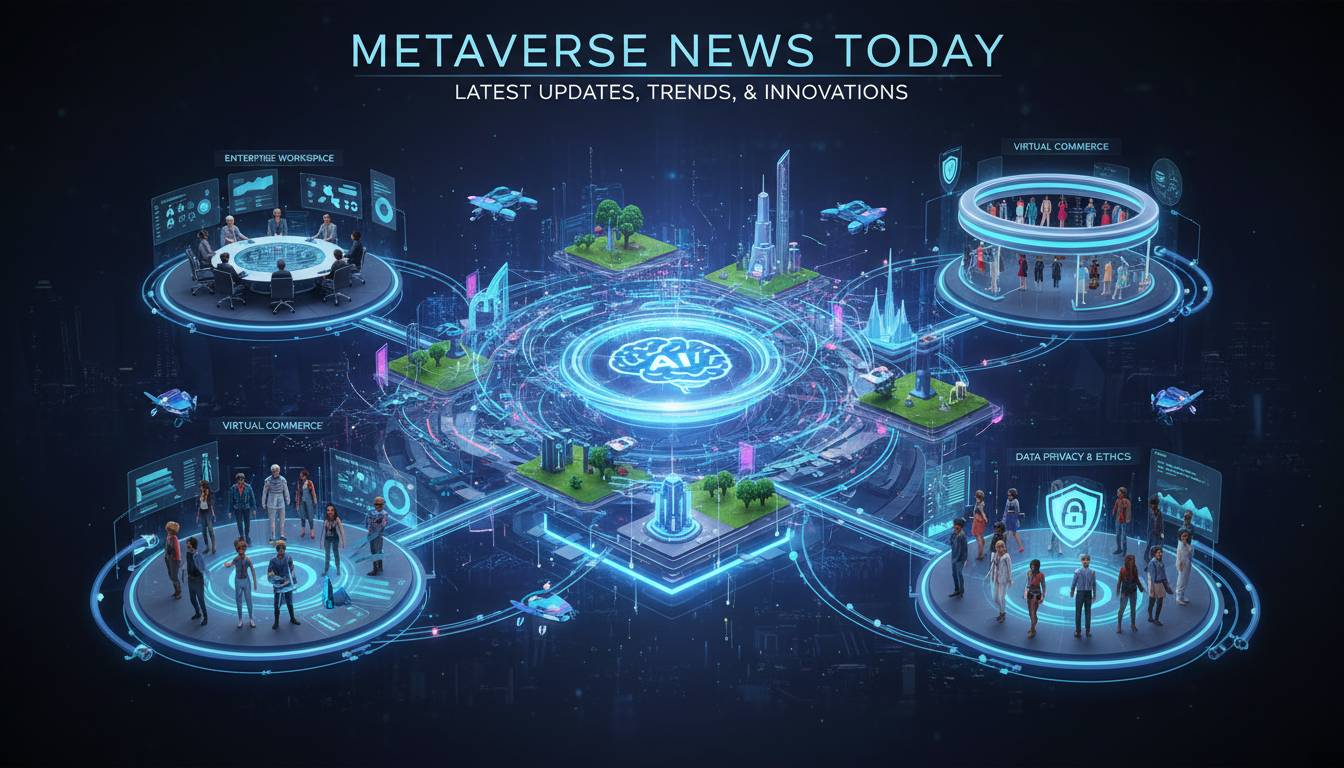
Metaverse news today reflects a tech world in transition. Major players like Meta are scaling back costly VR ambitions and reassigning focus to AI-powered wearables, while platforms such as The Sandbox undergo major restructuring. Meanwhile, enterprise and industrial applications of the metaverse are quietly gaining ground.
Meta’s Retreat from Metaverse, Embracing AI Wearables
Meta is cutting around 10% of Reality Labs staff—about 1,500 employees—as it shifts investments toward AI-driven devices like smart glasses and phone features. This is part of a broader retrenchment from metaverse-heavy initiatives toward more investor-friendly, practical technologies .
Reality Labs has accumulated more than $70 billion in losses since 2020, making the reduction of its footprint both necessary and symbolic of the company’s strategic pivot . CTO Andrew Bosworth acknowledged that, while cuts are a source of “sadness,” the company remains “bullish” on VR—but will reallocate resources toward areas with clearer growth, like AI glasses .
Stock Market Reaction: Metaverse Fatigue Alters Investor Sentiment
Meta’s stock climbed modestly in December when news surfaced of a 30% metaverse budget cut, signaling investor approval of a more measured approach . However, early 2026 saw renewed investor jitters as concerns mounted over whether reallocating funds from Reality Labs to AI would improve profitability—or just prolong costly cycles .
Some analysts, like those at Mizuho, suggest the cuts could spark a “significant” stock rally—if Meta can demonstrate better capital discipline and deliver tangible returns . But others warn that ramping up in another high-capex field might not assuage investor skepticism .
The Sandbox Slashes Workforce, Redirects Focus
Beyond Meta, The Sandbox—a blockchain-based metaverse platform—cut half of its staff. This move, influenced by AI advances reducing the need for large teams, also reflects broader waning enthusiasm and financial strain in the space .
Co-founders have stepped back, handing operations to Animoca Brands leadership. The platform is pivoting toward broader Web3 use cases, beyond pure metaverse play .
Enterprise Metaverse: Quiet Gains Continue
Meanwhile, industrial and enterprise metaverse applications are gaining traction, largely under the radar of consumer buzz. NVIDIA is pushing its Omniverse platform, while Niantic focuses on geospatial infrastructure for AR. Firms like Infinite Reality are building digital twins and immersive experiences, serving sectors from retail to events. Remarkably, about 61% of industrial entities surveyed are actively engaging with spatial computing and metaverse-like technologies .
Overview of Recent Metaverse Landscape
| Sector | Current Trend |
|———————|——————————————————————————–|
| Big Tech (Meta) | Retreat from VR-heavy metaverse in favor of AI wearables and mobile-first tools |
| Startups (Sandbox) | Major reshuffle to cut costs and pivot to sustainable Web3 ventures |
| Enterprise | Steady rise in industrial metaverse use—digital twins, AI integration |
This illustrates a tech industry recalibrating ambition, driven by practicality and ROI.
Looking Ahead: What To Watch
Mobile-First Horizon
Meta will increasingly direct Horizon Worlds and creator tools toward mobile, tapping into a broader user base and faster adoption curves .
AI Glasses as Strategic Frontier
Smart glasses powered by AI—particularly those in collaboration with EssilorLuxottica—are central to Meta’s renewed hardware strategy. The company may boost production capacity to 20 million units by the end of 2026 .
Resilience of Enterprise Metaverse Use
Even as consumer interest plateaus, industries continue applying metaverse tech for simulations, training, logistics, and virtual environments—highlighting long-term utility beyond novelty .
Conclusion
Today’s metaverse landscape signals a maturing vision. The initial hype gave way to fiscal reality—leading giants like Meta to retrench, realign, and rethink. AI wearables and mobile-friendly tools now anchor the strategy, offering more grounded paths to consumer engagement and profitability. Meanwhile, enterprise applications remain a quietly growing backbone, pointing to where the metaverse may find enduring purpose.
FAQs
1. Is the metaverse dead because Meta cut budgets?
Not at all. Meta is pivoting toward AI-powered wearables and mobile solutions. The metaverse concept continues—but under a leaner, more pragmatic umbrella.
2. Why is Meta laying off Reality Labs staff?
Reality Labs has been loss-making, with over $70 billion in cumulative losses. Layoffs reflect a shift toward cost-efficient investments in AI and immersive tech with better growth potential.
3. What’s happening with The Sandbox?
The Sandbox cut about 50% of its team, driven by lower funding and efficiency gains through AI. It’s repositioning toward broader Web3 services beyond virtual worlds.
4. Are metaverse technologies still growing anywhere?
Yes—particularly in enterprise. Industries like manufacturing, logistics, and retail use digital twins, spatial simulations, and AR tools. These applications are expanding quietly but noticeably.
5. What should consumers expect next?
More emphasis on accessible tools—like mobile-based horizons and AI glasses. Consumer VR may persist but play a smaller role as adoption strategies evolve.
6. Will AI kill the metaverse?
AI and the metaverse are converging rather than competing. AI tools enable smarter, more accessible immersive experiences—especially in enterprise and wearable contexts—keeping the metaverse alive in new forms.
















Leave a comment