
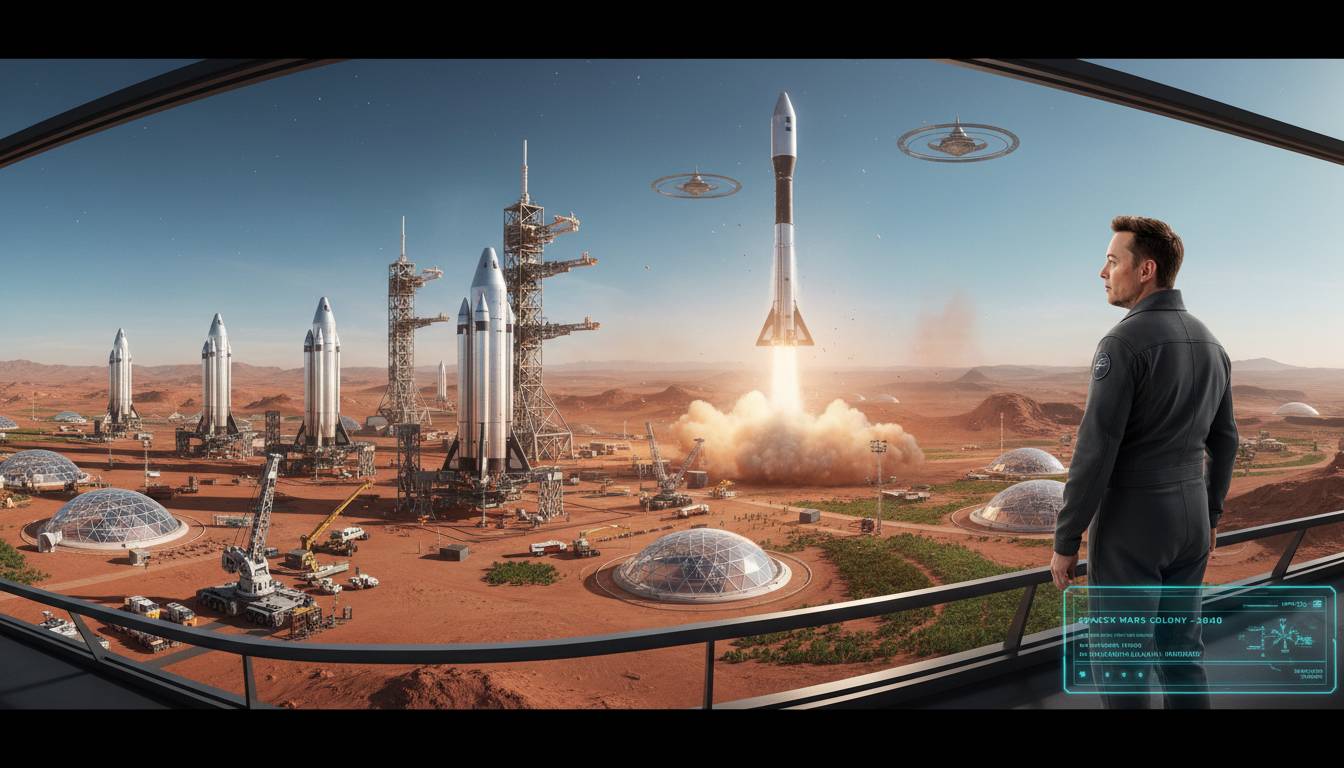
Elon Musk’s “build” spans electric cars, rockets, brain interfaces, AI, tunnels, and more. He builds with boldness—ranging from Tesla Robotaxis roaming U.S. streets to SpaceX pivoting toward lunar cities. Each project reflects a high-stakes experiment at the intersection of technology, infrastructure, and imagination.
Let’s unpack what he’s building now and what’s next.
Space Travel: From Mars to the Moon and Beyond
Elon Musk is steering SpaceX in a fascinating new direction. Instead of Mars as the immediate prize, Musk now favors building a self-growing city on the Moon, citing faster travel times and frequent launch windows—every 10 days—with missions lasting just two days. A Mars settlement still remains in the plan, but now projected for 5–7 years from now .
Alongside this lunar shift, Musk is melding space and AI by merging SpaceX with his startup xAI in a $1.25 trillion deal. Their joint mission? Launching solar-powered AI data centers into low Earth orbit, cooled naturally by space and fed via Starlink satellites .
This vision addresses the immense energy needs of AI without overloading Earth. But critics caution about heat management, space debris risks, and in-orbit maintenance hurdles .
Autonomous Electric Mobility: Robotaxis, Cybercabs, and More
Tesla’s Robotaxi finally launched in Austin in June 2025, though still under human supervision. Even so, it’s a milestone—world’s first city-scale autonomous ride-hailing in action .
At the same time, Cybercab—Tesla’s upcoming driverless, pedal-free car—is slated for production in April 2026. It symbolizes the future of Tesla as a robotaxi fleet builder, not just a carmaker .
Musk aims to scale this fast. He vowed to roll out hundreds of thousands or even a million fully self-driving Teslas in the U.S. by end of 2026. That’s thousands of cars doubling as mobile income generators in the Robotaxi network .
Neuralink: Bridging Brains and Machines
Neuralink is advancing steadily. By mid‑2025, its N1 brain-chip had been implanted in at least three people, enabling an ALS patient to speak via computer . The company is now expanding operations with an $8.2 million facility upgrade in Texas slated for early 2026 .
Its scope is broad: restoring motor control, vision, speech—eventually enhancing human-AI symbiosis.
AI Infrastructure: Grokipedia, Colossus, and Orbital Data Centers
Beyond space, Musk’s xAI is building in the AI realm too:
- Colossus, a supercomputer in Memphis, began operations in July 2024. Powered by Tesla Megapacks, it supports xAI’s Grok chatbot and other Musk ventures .
- Grokipedia, Musk’s AI-generated encyclopedia, launched in October 2025. It reached ~800k articles quickly, grew to over 5.6 million by early 2026, but usage has dipped dramatically since launch. Early GPT models even cited it—raising winds of reliability concerns .
Meanwhile, orbital AI centers are in the works—combining real-time connectivity, solar power, and AI compute in space to offload Earth-based infrastructure .
The Boring Company and Global Transport Plans
While less flashy than rockets, Musk continues work underground. The Dubai Loop was announced recently—a high-speed transit system powered by The Boring Company to slash commute times in the Middle East .
Beyond that, visionary ideas like a proposed transatlantic tunnel (maglev tube between New York and London in under an hour) also live on in concept, reminding us that Musk builds more than just rockets—he builds dreams .
Summing Up Musk’s Current Build Portfolio
| Domain | Key Projects & Insights |
|——————–|—————————|
| Space | Lunar city initiative, orbital AI centers, Mars future |
| Electric Mobility | Robotaxi launch, Cybercab production, self-driving fleet |
| Neural Tech | Neuralink implants, Texas expansion |
| AI Infrastructure | Colossus supercomputer, Grokipedia, space-based AI compute |
| Urban Transit | Dubai Loop, tunnel ideas |
What stands out? Musk’s build isn’t just about devices or rockets—it’s about systems. Interconnected, bold, and rife with risk—but undeniably transformative.
“Space offers abundant solar energy and a natural cooling system”—a visionary take that reframes space not just as frontier, but infrastructure .
Conclusion
Elon Musk is aggressively building across diverse frontiers: autonomous vehicles, brain-computer links, artificial intelligence, orbital infrastructure, and even underground transit. What ties these ventures together isn’t just ambition—it’s a systems-based mindset that reimagines how we live, move, think, and compute.
To follow what comes next, watch for Cybercab production in 2026, Neuralink’s facility expansions, rollout of self-driving fleets, lunar city progress, and the bold vision of AI data centers orbiting Earth.
FAQs
Q: What’s a “self-growing city” on the Moon?
A lunar settlement concept that expands with each mission—designed to be built incrementally over time, unlike Mars plans which require lengthy launches and longer travel times .
Q: When will Tesla’s Cybercab be available?
Production is scheduled to begin in April 2026, intended for fully autonomous ride-hailing networks .
Q: What is Colossus?
A supercomputer built by xAI in Memphis, powered by Tesla Megapacks. It supports AI tasks like training Grok and serves Musk’s broader tech ecosystem .
Q: How successful is Grokipedia?
Launched in late 2025, Grokipedia grew fast—peaking at ~460k daily visits—but settled to around 35k, and has drawn scrutiny for bias and accuracy issues .
Q: What is the Dubai Loop?
An advanced underground transit system under development by The Boring Company in Dubai. It intends to revolutionize city travel with high-speed tunnels and align with smart city goals .
Q: What challenges face orbital AI data centers?
Key hurdles include managing heat in space, handling space debris risks, in-orbit hardware failures, and high initial launch costs .