
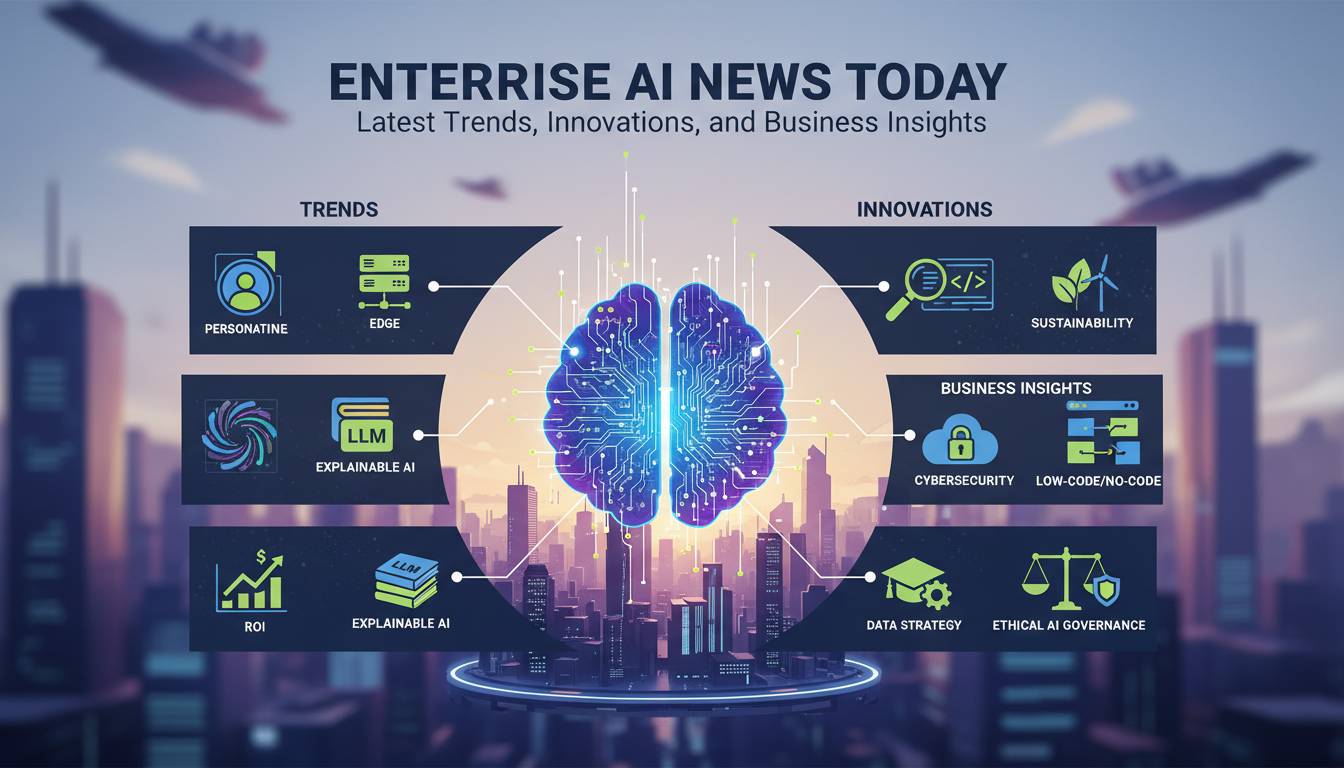
Today’s enterprise AI story centers on precision, production, and purpose—not hype. Businesses aren’t just experimenting; they’re stepping into real-world deployments. From agentic AI platforms to massive infrastructure bets and corporate deals reshaping AI strategy—these developments mark a pivotal shift in how organizations use AI to compete, govern, and grow.
Frontier: OpenAI’s Enterprise AI Agent Hub
OpenAI recently launched Frontier, a platform built to help large organizations build, deploy, and manage AI agents across diverse environments—be it cloud, on-prem, or local. Designed to tackle “agent sprawl,” Frontier aims to bring context, onboarding, feedback loops, and permission controls to AI agents, mirroring workplace norms. Early adopters include Intuit, Uber, State Farm, HP, Oracle, and others, showcasing the demand for integrated AI orchestration. By positioning agents as digital collaborators—not disjointed tools—Frontier underscores a maturation in enterprise AI strategy.
Why this matters
- It signals a move beyond one-off AI experiments toward enterprise-ready platforms.
- OpenAI is competing head-to-head with Anthropic and Google.
- Frontier reflects a shift: enterprises now need structure, governance, and identity for AI agents, not just raw capability.
C5i’s Agent5i: Enterprise Workflows, Smarter
In a similar move, C5i unveiled Agent5i, a unified platform to integrate autonomous agents for streamlined decision-making. Built for cloud, hybrid, and on-prem environments, it promises intelligence, governance, and systems integration under one roof.
A noteworthy detail: Agent5i is clearly aimed at enterprises ready to scale AI across workflows—not just pilot isolated tasks.
AI Security and Governance Under the Spotlight
Security is now centre stage. Varonis Systems is acquiring AllTrue, an AI risk and security specialist, for $125 million in cash. This signals mounting concern over AI governance, bias, and model oversight as autonomous systems become mainstream. This move follows similar acquisitions by Veeam and Cato Networks, highlighting one core trend—AI can’t just be smart; it must also be safe and trustworthy.
What’s driving this
- Governance and risk have become board-level considerations.
- Enterprises are consolidating oversight tools to manage AI growth responsibly.
- Securing autonomous AI is now non-negotiable.
Amazon’s Huge $200B AI Bet Sets the Stage
Amazon just unveiled a jaw-dropping $200 billion capital expenditure plan for 2026—with AI infrastructure as the driving force. This dwarfs Wall Street forecasts by over $50 billion, rattling investors despite CEO Andy Jassy defending it as vital for scaling AI across AWS and beyond. Amazon’s AI chip ecosystem (Trainium, Graviton) is projected to generate over $10 billion in revenue this year, underscoring its in-house hardware strategy.
Broader implications
- AI infrastructure is becoming a competitive battleground.
- Major players are doubling down—betting on long-term demand from enterprise AI.
- We’re entering an era where infrastructure equals strategic advantage.
Anthropic and Accenture: Partnership That Speaks Volumes
Anthropic’s partnership with Accenture marks a fresh wave in enterprise AI adoption. Accenture will train 30,000 employees on Claude, Anthropic’s AI model, while helping deploy solutions across regulated sectors like finance and healthcare. This collaboration shows that enterprises are less interested in flash-in-the-pan AI pilots—and more in embedded, scaled, and trusted AI capabilities with consulting muscle behind them.
Harness Scores Big and Eyes India Expansion
Harness, an enterprise AI company, raised $240 million in funding, raising its valuation to $5.5 billion. Backed by Goldman Sachs, IVP, Menlo Ventures, and Unusual Ventures, the firm plans aggressive hiring in India to support growth. The large round signals investor confidence and points to growing demand for enterprise AI infrastructure.
Productivity Claims vs. Pilot Purgatory
OpenAI and Anthropic jointly presented research showing average daily time savings of 40–60 minutes for enterprise workers, and task completion time cuts up to 80%. Skeptics note that academic studies show many AI projects underdeliver, though vendors are pushing back with optimistic productivity stats.
Meanwhile, a Business Insider report hints at a slight pause in enterprise AI spend—from 44.5% to 43.8% of businesses paying for AI services—which may reflect broader cautiousness amid inconsistent returns.
The Bigger Picture: Enterprise AI Trends in 2026
1. From Pilot Haze to Production Scale
Most companies are still stuck in pilot purgatory, but enterprise-scale deployment is accelerating. Agentic AI in production nearly doubled—from ~7.2% to 13.2% in four months. High-volume API usage and repeating workflows suggest real traction.
2. Precision Over Volume
Generic AI agents are falling out of favor. Enterprises are opting for domain-specific, focused solutions—like agent tools for biotech clinical trials, insurance underwriting, and energy grid control.
3. Financial Stewardship: FinOps and ROI Drive Spend
AI budgets are under scrutiny. FinOps is rising in importance as C-suites demand measurable AI ROI. Some favor outcome-based pricing over token usage, tethering costs to business impact.
4. Governance Matures
AI governance moves from reactive to proactive. Governance-as-code, observability pipelines, and federated frameworks are emerging as must-haves.
5. Agentic Ecosystems Replace Monolithic Models
Enterprises are pivoting from “one big agent” to multi-agent systems—modular, cooperative, and context-aware. Platforms like Frontier and Agent5i are practical steps in this direction.
6. Data Foundations Power AI
Semantic layers, knowledge graphs, and real-time data pipelines are closing the gap between enterprise systems and AI agents.
Summary
Enterprise AI is evolving—and fast. This isn’t about trendy chatbots anymore; it’s about delivering accountable, intelligent, and scalable systems with business value baked in. Platforms like Frontier and Agent5i, acquisitions like Varonis–AllTrue, and partnerships such as Anthropic–Accenture show that AI integration is becoming strategic, governed, and tailored—not experimental.
Entering 2026, leaders are prioritizing production scalability, safety, governance, and outcome-driven spending. Agentic AI isn’t just a tool—it’s becoming a structural force in enterprise workflows.
Organizational advantage now hinges on:
- Consolidated AI platforms with governance built in
- Domain-specific agents solving real business pains
- Financial discipline and ROI accountability
- Well-structured governance and risk frameworks
- Seamless data infrastructure supporting AI agents
FAQs
What is “agent sprawl” and why does it matter?
“Agent sprawl” refers to scattered, siloed AI agents that lack integration and oversight. Fixing it is crucial—platforms like Frontier offer centralized onboarding, context sharing, and control to make AI agents scalable and safe.
Why are enterprises opting for multi-agent systems over monolithic AI?
Multi-agent systems allow specialization, collaboration, and policy-aware actions. They align better with complex workflows and governance needs than single, overreaching AI models.
Are enterprises seeing real ROI from AI now?
Some report productivity gains—like time savings and faster task completion—but overall adoption remains cautious. Many still linger in pilots, but production-grade deployments are gaining traction rapidly.
What role does governance play in enterprise AI?
It’s central. Governance-as-code, real-time monitoring, risk scoring, and federated oversight frameworks are now critical, as enterprises must ensure AI acts reliably, ethically, and compliantly.
Why are domain-specific AI solutions on the rise?
Generic AI agents often fail to capture context or industry complexity. Focused solutions—like those for life sciences, insurance, or energy—drive clearer business impact with better precision.
What’s pushing AI budgets and adoption into 2026?
A shift from hype to discipline. Decision-makers demand proof of impact, tighter cost control, and trusted systems. Infrastructure bets, like Amazon’s $200B plan, underscore the long-term scale entering enterprise AI.