

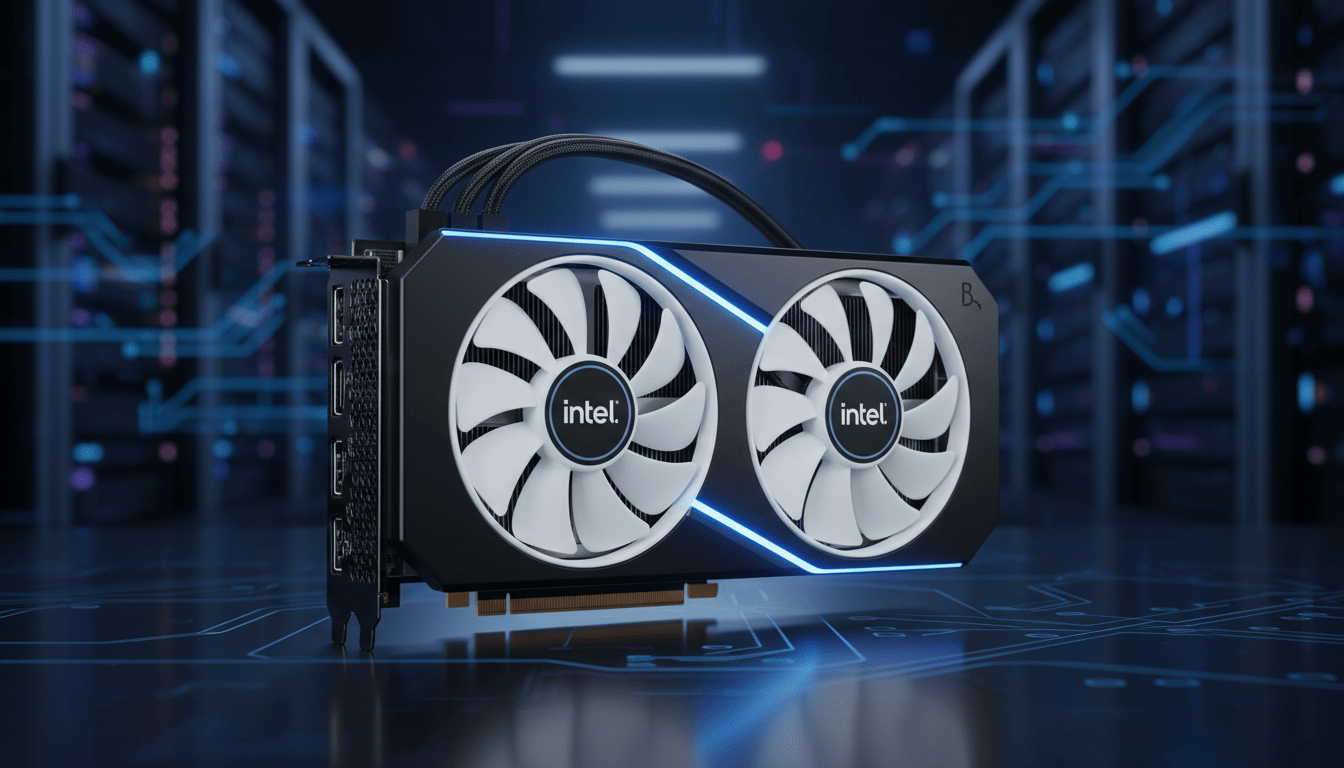
Here’s the scoop on Intel GPU developments. Intel has cancelled its upcoming Arc B770 gaming GPU due to surging memory costs, but continues advancing performance technology—like XeSS 3 Multi‑Frame Generation (MFG)—and strengthening its lineup with new Battlemage cards, driver optimizations, and pro-grade Arc Pro GPUs. Let’s dive into what’s new and what matters for gamers, creators, and professionals.
Battlemage Era: B580/B570 Hit the Market
Intel stepped into early 2025 with the launch of the Arc B580 and B570 GPUs, priced at $249 and $219 respectively . Positioned as budget competitors, these cards target 1440p gaming and, in certain titles, outperform Nvidia’s RTX 4060 by about 10% on average . That’s a bold claim—and it appears credible in many gaming scenarios, though still game-dependent.
These Battlemage GPUs use the Xe2 architecture and introduced XeSS 2 AI upscaling with frame generation and low-latency modes . It’s a solid start for Intel in the discrete GPU space.
XeSS 3 with Multi‑Frame Generation Comes Alive
Intel launched XeSS 3 with Multi‑Frame Generation (MFG), enabling up to three AI-generated frames inserted between each rendered frame . Unlike Nvidia’s MFG locked to RTX 5000 series, Intel’s version works on older hardware like Alchemist and Xe2 integrated GPUs .
The update rolled out alongside Intel’s Core Ultra Series 3 “Panther Lake” CPUs in early 2026. These chips feature Xe3 graphics with significantly improved efficiency and ray tracing . Around 45 games already support XeSS 3 MFG, showing promising performance gains and smoother frame pacing—some early reports even note responsiveness surpassing Nvidia’s version .
Driver Updates: Refining Performance and Stability
Intel has been busy polishing its software stack. A March 2025 “Game On” driver (v32.0.101.6651) boosted performance in Call of Duty: Black Ops 6 by up to 15% at 1080p and 12% at 1440p on Arc B-series hardware . That’s a helpful bump for B570/B580 users.
June 2025 brought a targeted hotfix (v32.0.101.6877) addressing audio glitches on handheld systems like the MSI Claw 8 AI+. Good to see handheld form factors getting support .
Late 2025 driver (v7028) tackled underperformance on mid-range CPUs (like Ryzen 5 5600). Tests showed as much as 36% performance improvement in Cyberpunk 2077, helping Arc cards catch up to Ryzen-compatible rivals .
Finally, the XeSS 3 MFG driver (v32.0.101.8425/8362) enhanced Arc GPU performance and compatibility across both discrete and integrated GPUs—and delivered better frame pacing compared to Nvidia’s equivalent .
Arc A-Series EOL, Arc Pro Advancements
Intel is phasing out several earlier Arc GPUs. The A750 Limited Edition and entire A-series mobile lineup will reach End of Life, with final shipments expected by mid‑2026 .
At the same time, Intel introduced new professional GPUs: Arc Pro B60 (24 GB) and B50 (16 GB), optimized for AI inference and creative workflows . These Xe2-based GPUs expand memory and ray tracing power for professionals—which suggests Intel sees stronger opportunity in workstation markets.
B770 Cancelled, But Rumors Persist
Despite hype around the Arc B770, Intel has officially cancelled the project. The GPU was expected to feature the G31 chip, 32 Xe cores, and 16 GB memory—targeting competition with Nvidia’s RTX 5070. But soaring memory prices and development costs made it financially untenable .
Still, shipping data shows a mysterious 300 W Intel GPU—likely the B770 design—surfaced recently, possibly signalling a high-end card was in the works . Rumors continue that B770 (16 GB) may yet appear if market conditions improve . For now, though, it’s officially off.
Strategy Shift: Pro Focus, AI Frame Boosting, and Talent Acquisition
Intel’s strategic focus seems to be shifting. With the B-series gaming GPU dropped, the company is leaning into XeSS 3 MFG and professional GPUs to deliver performance gains across use cases.
Adding weight to that, Intel’s CEO announced the hiring of a top GPU architect from Qualcomm—sending a “we are coming” message to Nvidia . This move suggests renewed ambition in GPU architecture and future product innovation.
Summary of Key Developments
- Arc B580 and B570 launched in late 2024/early 2025, delivering decent 1440p performance and AI upscaling (XeSS 2).
- XeSS 3 MFG debuted in early 2026 with Panther Lake CPUs, offering multi-frame generation and broad GPU support.
- Drivers across 2025–2026 improved performance in games (Black Ops 6, Cyberpunk 2077) and fixed issues in handheld audio.
- Arc A-series GPUs are being phased out—but Arc Pro B-series cards aim at professionals and AI workloads.
- The Arc B770 was cancelled due to financial constraints, though hints of it linger in shipping logs and rumors.
- Intel is investing in pro GPUs and advanced frame-gen tech—and has acquired GPU leadership talent.
Conclusion
Intel’s GPU lineup is evolving fast. While the consumer-focused B770 was shelved, the success of Battlemage GPUs, XeSS 3 MFG, and Arc Pro cards shows Intel is pivoting toward performance gains through AI and prosumer solutions. Expect greater focus on professional and AI applications while watching for possible high-end consumer returns. For now, Arc B580/B570 and XeSS 3 MFG are the story—deliver tangible value, while Intel recalibrates for the road ahead.
FAQs
What is XeSS 3 MFG and why does it matter?
XeSS 3 Multi‑Frame Generation inserts AI-generated frames to boost effective FPS—up to triple or quadruple in some cases—and works on older Arc and integrated GPUs, not just new hardware.
Is the Arc B770 coming out?
No—the Arc B770 gaming GPU has officially been cancelled due to rising memory costs and overall project expense.
Which GPUs are being phased out?
The Arc A750 Limited Edition and all Arc A-series mobile GPUs are being discontinued, with final shipments by mid‑2026.
Are there new professional Intel GPUs?
Yes. Intel announced Arc Pro B60 and B50 GPUs with up to 24 GB memory, optimized for AI inference and creative professional workloads.
Have Intel drivers improved gaming performance?
Yes. Recent driver updates have delivered double-digit FPS gains in major titles, fixed audio and stability issues, and optimized performance on lower-end CPUs.
Will Intel return to gaming GPUs after B770?
Intel continues investing in GPU talent and technology. While the B770 was scrapped, future high-end gaming GPUs remain possible if market conditions improve.