
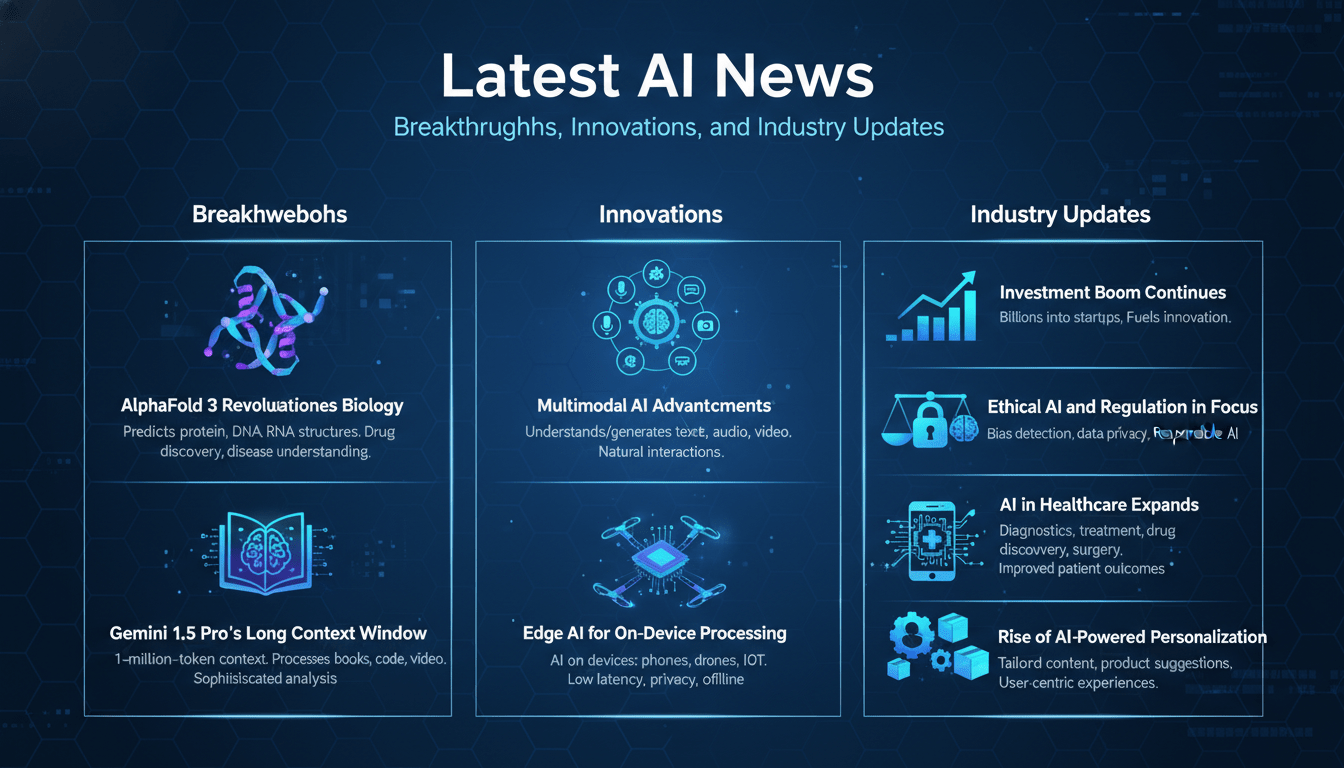
The latest AI news reveals a powerful surge in infrastructure investment, game-changing hardware releases, and breakthroughs in agentic systems—even as markets and resources feel the pressure. Big Tech is pouring hundreds of billions into AI, while hardware makers unveil chips and models that promise smarter, faster, and more autonomous AI.
AI Infrastructure Booms Amid Market Jitters
Major tech firms are doubling down on AI, with collective spending projected to reach around $650–700 billion in 2026. That massive investment fuels data centers and chip development—but it’s also rattling investors, triggering intense scrutiny of ROI and fears of overheating markets.
- The explosion in spending is straining resources, causing shortages in skilled labor and semiconductors. Apple and others are already feeling the pinch in device component supply chains.
Semiconductor Surge and Infrastructure Strains
The semiconductor industry is on track to smash records, forecasted to exceed $1 trillion in global sales in 2026, thanks in large part to AI demand for accelerators, high-bandwidth memory, and networking gear.
Meanwhile, the AI boom is creating ripple effects across the economy—pushing up costs and creating shortages, particularly in construction and skilled trades, as data center builds crowd out other projects.
AI Chips Redefined at CES and Beyond
CES 2026 witnessed major debuts: Nvidia launched its ultra-powerful Vera Rubin chip, boasting up to three times the speed and five times the AI inference performance of previous models. This platform is aimed at complex workloads and is already being adopted by AWS and OpenAI.
Beyond chips, new AI-driven systems stole the show—from autonomous vehicle platforms to humanoid home robots and AI-integrated toys. These products hint at how AI is spreading into everyday experiences.
Hardware Diversifies: Competition and Cooling Innovations
The AI chip landscape is broadening as AMD, Huawei, and others stake their claim. AMD’s MI400 and MI500 aim to rival Nvidia; liquid cooling is becoming mainstream to manage dramatic thermal loads, with usage expected to reach nearly 47% of data centers by 2026.
Agentic AI, Autonomous Models, and Platform Embedding
AI is getting smarter—and more independent. OpenAI partnered with Cerebras to deploy wafer-scale compute, promising up to 15× faster inference, a major shift away from GPU dependency.
Agentic AI systems, capable of multi-step reasoning and real-world execution, are becoming real. Industry watchers report inference costs dropping by as much as 70–80% year-over-year, making AI viable at scale.
Anthropic rolled out a legal plugin for Claude that automates contract review—and nearly tanked the legal-tech sector overnight. This marks a transition from API-only models toward integrated workflows.
Anthropic also embedded productivity tools—Slack, Asana, Figma—into Claude’s interface, turning it into a central workspace hub without context-switching.
Meanwhile, Google’s Project Genie lets users generate and explore interactive 3D worlds from text prompts—pushing AI from static interfaces into immersive, navigable environments.
Human-Centered AI and Bold Education Moves
Startup Humans&, founded by alumni from Anthropic and xAI, raised $480 million in a landmark seed round to build AI that enhances human work rather than replacing it.
At Davos, OpenAI launched “Education for Countries,” aiming to integrate AI tools like ChatGPTEdu and GPT‑5.2 into public education systems—marking a push toward equitable AI access worldwide.
Apple Leverages AI with Privacy in Focus
Apple acquired Q.ai, an Israeli startup specializing in imaging and machine learning, in a significant move to boost Siri’s capabilities—without compromising privacy. The same month, Apple announced plans to integrate Google’s powerful Gemini model into Siri, running securely on private cloud infrastructure.
Global Strategy: AI Diplomacy and Summit Governance
U.S. tech spending is under geopolitical scrutiny. Trump’s CTO has launched a strategy to export American AI globally, shifting focus from regulatory caution to broader international adoption.
India is ramping up global outreach too. The AI Impact Summit in New Delhi (Feb 16–20) and the BioAsia 2026 summit in Hyderabad (Feb 17–18) will unite decision-makers on AI’s role in industrial and biotech innovation.
Infrastructure Bottlenecks Ahead: Forecasting the Gap
A recent forecast model shows that by 2036, AI agent populations could grow 100×, pushing global bandwidth demand from 1 exabyte/day in 2026 to more than 8,000 EB/day—nearly 8,000× growth. Without smart redesign, by 2030 edge and network systems could have 70% capacity strain by 2033.
Expert Takeaway
“The future isn’t about replacing humans,” says Microsoft’s Aparna Chennapragada. “It’s about amplifying them.” AI as collaborator—not rival—is the next frontier.
Conclusion
The AI landscape in early 2026 is both exhilarating and cautionary. Game-changing hardware, agentic models, and human-AI synergy are pushing boundaries. Yet, skyrocketing infrastructure demand and market jitters remind us that scaling responsibly matters. Watching how innovation, policy, and global collaboration evolve alongside booming investment will define whether AI becomes a force for inclusion—or exclusivity.
FAQs
What’s driving AI infrastructure spending in 2026?
Major tech firms are ramping up AI data centers, chip development, and compute capabilities—leading to forecasts of $650–700 billion in spending. Investor skepticism remains, though, over returns on such heavy investment.
Why are inference costs dropping so fast?
Advances like wafer-scale compute and optimized hardware are making inference far faster and cheaper—up to 15× gains—enabling AI to scale into real-world, revenue-generating systems.
What’s agentic AI, and why does it matter?
Agentic AI refers to systems that plan, reason, and act autonomously over multiple steps. Its rise marks a shift from chat-based models to tools that interact with real systems and workflows.
How is AI affecting global resource chains?
AI demand is straining semiconductors, skilled labor, and supply chains, causing shortages and price pressure across sectors—especially in data center construction and hardware.
What steps are governments taking in AI strategy?
The U.S. is pushing AI exports and international adoption, while India hosts summits like the AI Impact Summit to shape governance and industrial AI futures.
What’s the biggest threat to future AI scaling?
Infrastructure bottlenecks—such as bandwidth and edge network saturation—could hit critical mass by 2030 unless we redesign AI-native systems for distributed, efficient, and scalable operations.