

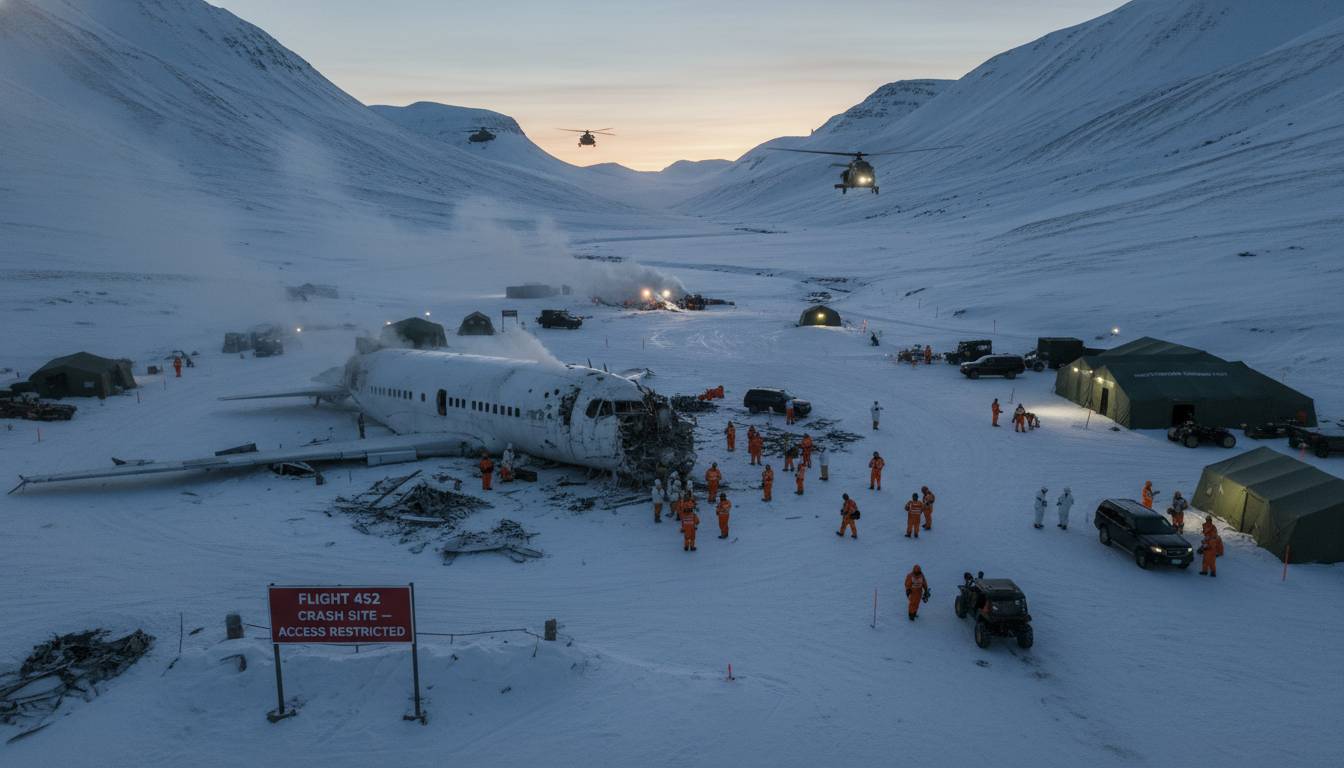
The final minutes of a fatal passenger jet’s descent hold the key to understanding what went wrong—and investigators are racing to unlock that data to prevent similar disasters. In recent high-profile aviation tragedies, black boxes have become central in reconstructing the last moments, though they sometimes fall silent just before impact, complicating the investigation.
Black Boxes: Guarding—or Failing to Guard—the Truth
Flight recorders—commonly known as black boxes—are vital for piecing together crashes. They store cockpit conversations (CVR) and flight data (FDR), offering investigators insight into technical malfunctions, human error, or environmental conditions.
- In a South Korean crash involving a Boeing 737-800, officials revealed that both recorders stopped capturing data approximately four minutes before impact.
- Investigators promptly sent these devices to the NTSB in the U.S., attempting to recover any viable information despite the missing data.
Those final, unrecorded minutes can hold critical clues—missed alarms, pilot responses, or system failures. Without them, investigators must rely more heavily on physical evidence and radar.
When Fuel Shutoff Pulls the Trigger
In an Air India Boeing 787-8 crash near Ahmedabad, deadly consequences followed when the engines were starved of fuel moments after takeoff. The fuel control switches were found to have been moved from “run” to “cut-off,” causing immediate power loss.
- Cockpit voice recordings revealed confusion among the pilots about who operated the switch.
- Families criticized the preliminary report, arguing it overlooked whether the switch change was due to human error, mechanical failure, or electrical issues. The design includes safeguards making accidental movement unlikely.
This tragedy underscores how a split-second action—human or otherwise—can grimly determine a flight’s fate.
Mid-air Collision: A Complex Urban Skies Collision
The mid-air collision near Washington, D.C., between a U.S. Army Black Hawk helicopter and an American Airlines CRJ-700 highlighted the chaos in congested airspace.
Key Findings:
- A 3D reconstruction revealed how lights, night vision goggles, and the city skyline led the helicopter crew to misidentify the jet.
- The helicopter was flying above its allowable ceiling, at around 270 feet, while the jet was at approximately 320 feet—unsafe vertical proximity.
- Air traffic was so dense that controllers were overwhelmed, managing over 20 aircraft from two positions. They relied on visual separation rather than radar—known as a “push the line” tactic.
- Altimeter misreadings (off by 80–100 feet) and non-working ADS-B locators complicated spatial awareness.
“The conflict alert in the ATC tower was clearly audible for 20 seconds before the collision… highlighting a critical lapse in safety protocol.”
Why Final Minutes Matter – and Sometimes Fail
Black boxes are meant to keep recording until impact. But:
– In some cases, they shut down early due to physical damage or power loss.
– In South Korea, the Jeju Air crash recorders stopped four minutes early, a frustrating gap that hampers clarity.
– In D.C., though the recorders were recovered intact, the crowded airspace and technical glitches added layers of complexity.
These gaps force investigators to rebuild scenarios using radar, debris, ATC logs, and witness accounts.
Lessons from the Field: Patterns and Path Forward
Combining Data Sources
When black boxes fall silent, experts pivot:
– Radar tracks.
– ATC communications.
– Wreckage mapping.
– Survivor or witness testimonies.
Human Factors Matter
Confusion or overload—whether in pilot response or controller decision-making—often surfaces in these tragedies.�especially under stress.
System Flaws Are Culpable Too
Misfitting altimeters, flawed switch designs, and unreliable recording systems aren’t just tech glitches—they’re safety threats.
Safety Culture is Crucial
D.C.’s case revealed a culture where controllers were implicitly tasked with “making it work” under pressure—skirting safety margins to maintain flight flow.
Conclusion
Investigators race to decode the final minutes of a passenger jet tragedy—not just to satisfy curiosity, but to prevent future tragedy. Black boxes, though essential, sometimes fail us, leaving gaps that force deeper, multi-dimensional analysis. From South Korea to India to Washington D.C., the arc of failure often intertwines human error, technical shortcomings, and structural pressure. Only by examining each of these in context can meaningful change take flight.
FAQs
Why do black boxes sometimes stop before a crash?
They can fail due to physical damage, power loss, or extreme conditions. Without them, investigators turn to external data like radar and debris mapping for clues.
How can air traffic control practices contribute to crashes?
Controllers under heavy workloads may rely on visual separation rather than radar-based instructions. This increases risk, especially in congested airspace.
What happens when pilots and crew are confused by instruments?
Misreading altimeters or misidentifying aircraft lights—especially when using night vision—can cause dangerous miscalculations in flight paths.
Do cockpit voice recordings always reveal pilot error?
Not always. Sometimes they reveal confusion, miscommunication, or system anomalies—but they don’t automatically point to blame.
What safety changes follow such investigations?
Agencies may mandate better maintenance checks, redesign safety switches, update flight routes, and limit certain airspace during peak traffic to reduce risk.